

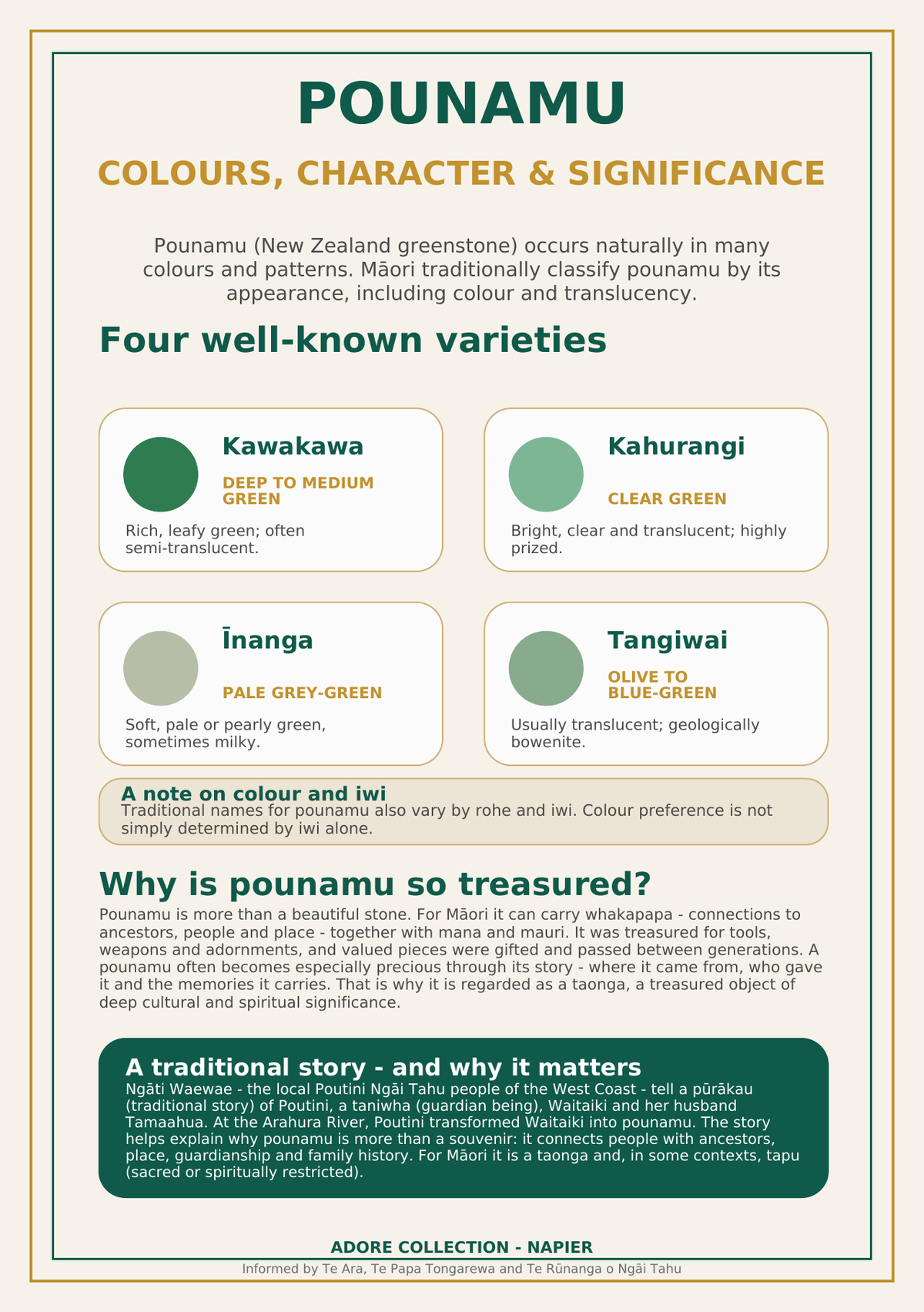
Want to know more ... then read on!
The Story of Poutini, Waitaiki and the Origins of Pounamu
There are several Māori traditions explaining the origins of pounamu. One well-known version comes from Poutini Ngāi Tahu, the people of the West Coast of Te Waipounamu, the South Island.
In this pūrākau — traditional story — Poutini is a taniwha and guardian associated with pounamu. A taniwha is a powerful supernatural being in Māori tradition; some are guardians and protectors, while others can be dangerous. Poutini is remembered as a guardian of both the people of the West Coast and the mauri, or spiritual life force, of pounamu.
The story begins when Poutini travels to Tūhua, or Mayor Island, in the Bay of Plenty. There he sees a beautiful woman named Waitaiki bathing. Captivated by her, Poutini takes her and flees south. Waitaiki’s husband, Tamaāhua, discovers that she is missing and sets out in pursuit. According to the tradition, he uses karakia and divination to follow their path through Aotearoa.
The journey takes them through a remarkable series of places associated with valuable stone resources before eventually reaching the West Coast of the South Island. Because of this, the story is more than simply an origin tale: it has also been described as an oral map of important stone sources and traditional trade routes.
Eventually Poutini reaches the Arahura River with Tamaāhua close behind. Knowing that he may be caught, but refusing to surrender Waitaiki, Poutini transforms her into his own essence — pounamu — and leaves her within the riverbed. The Arahura River and nearby Waitaiki Stream subsequently become important sources of pounamu.
When Tamaāhua finally arrives, he finds that Waitaiki has been transformed into īnanga pounamu, a pale variety of the stone. He grieves for her before returning home. Poutini escapes to the sea and, in the tradition, continues to travel the West Coast as guardian of the land and its pounamu. This connection is reflected in the Māori name for the West Coast, Te Tai Poutini — the tides of Poutini.
Why does this make pounamu so important?
The story helps explain why pounamu is much more than an attractive green stone.
For Māori, pounamu can carry connections to whakapapa — ancestry and relationships between people and place — as well as mana, mauri and generations of history. Pounamu has traditionally been valued for its strength, durability and beauty, and was fashioned into important tools, weapons and adornments. Highly significant pieces were gifted, traded and passed down through generations.
Its value therefore extends well beyond its physical appearance. Pounamu has associations with chiefly status, peace-making and important relationships, and can carry mana and, in particular contexts, tapu.
A particular piece may become precious because of where it came from, who gave it, who wore it and the memories and relationships associated with it. This is why pounamu is described as a taonga — a treasured possession of deep cultural and spiritual significance.
The traditional story of Waitaiki adds another layer to that meaning. In the story, pounamu is not simply discovered in the land: it emerges from a story involving people, place, loss, transformation and guardianship. That helps explain why the stone is treated with such respect.
A note for visitors
You may hear pounamu called New Zealand greenstone or New Zealand jade, but “pounamu” carries much more cultural meaning than either English term.
It is also worth remembering that Māori traditions are not all identical. Different iwi have their own histories, names and traditions surrounding pounamu, so the story above is one important tradition rather than the only explanation of its origins.